Choosing new diagnostic imaging equipment is a long-term investment, not just a purchase. The right system depends on where it will be used, who will be using it, and what kind of exams it needs to support day to day. This guide walks through the main considerations for two of the most common categories we supply: colour Doppler ultrasound systems and video endoscopy platforms.
Browse our full range of TGA-registered SonoScape products to see current models, or read on for guidance on narrowing down what fits your practice.
Trolley (cart-based) vs portable ultrasound systems
The SonoScape range we supply spans two broad formats, and the right choice usually comes down to where the system will live and how often it needs to move.
Trolley systems
Cart-based systems such as the P60, S60, P50, P40, P20, P15, P10 and P9 are built for a fixed or semi-fixed scanning room. They typically offer a larger monitor, more onboard processing power, and a broader set of imaging applications, which suits departments running a high volume of general, women's health, or vascular imaging from a dedicated room.
Portable systems
Laptop-style and handheld-class systems such as the X5, X3, S9 Pro, S9, S8 Exp, E3 Premium, E2 and E1 are designed to move with the clinician. These suit outreach clinics, ward rounds, point-of-care scanning, and practices that need full diagnostic capability without a dedicated scanning room.
If you're deciding between a cart-based and portable system, enquire about a specific model and our team can help match a system to your exam mix and available space.
Video endoscopy systems for gastroenterology
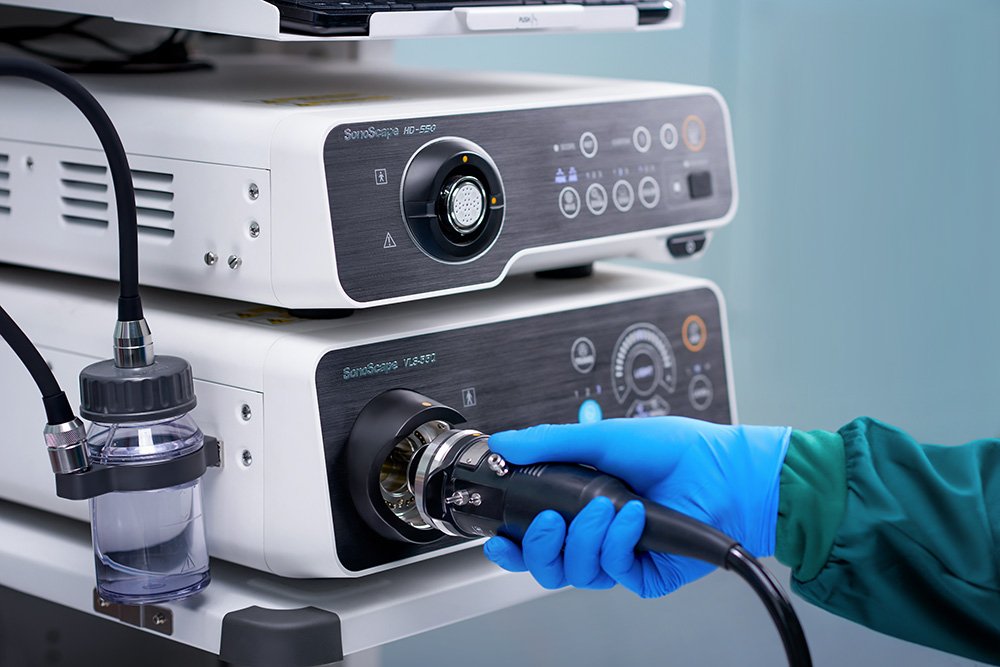
On the gastroenterology side, the HD-500 and HD-550 video endoscopy systems are built around SonoScape's HD processor platforms, with chromoendoscopy imaging modes designed to improve mucosal and vascular contrast during procedures.
The HD-550 steps up to a full-HD 1080p image with a 4-LED light source and dual imaging modes (SFI and VIST), an ergonomic scope handle, and a shorter bending radius intended to make intubation smoother. The HD-500 pairs an integrated CMOS sensor with VIST chromoendoscopy and an onboard hard drive for case recording and archiving, making it a strong option for practices that need dependable day-to-day endoscopy without the top-tier image specification.
Questions worth asking before you buy
- What exam types make up most of your caseload, and does the system's application set cover them?
- Will the equipment stay in one room, or does it need to move between rooms or sites?
- Who will be operating it day to day, and what's their experience level with the platform?
- What installation, calibration, and ongoing servicing support is available after purchase?
That last point matters as much as the equipment itself. Our medical imaging and installation services cover setup, calibration and workflow integration once your new system arrives, and our technical support and troubleshooting services are there if something needs attention down the line.
Compliance and TGA registration
Every ultrasound and endoscopy system we supply is a TGA-registered import, which matters if your facility needs to reference registration status as part of procurement or compliance documentation. Our compliance and regulatory services can help with the calibration and performance testing paperwork once equipment is installed.
Final thoughts
There's no single "best" ultrasound or endoscopy system — the right choice depends on your caseload, your space, and how the equipment fits into your existing workflow. If you're not sure where to start, tell us what you're trying to achieve and we'll help narrow down the options.